

"Am I affected by refractive error? What is refractive error?"
Refractive errors
WHO estimates that 153 million people worldwide live with visual impairment due to uncorrected refractive errors. What is refractive error?
Vision is an interpretation of light rays reflected by objects which are converted to electrical impulses when they hit retina. The electrical impulses are then sent to the brain to form an image. Retina is a layer of the eye situated at the back of the eye containing light-sensitive cells. Refractive errors happens when lights are not focused correctly. This happens the eye is imperfectly shaped. The eye’s ability to focus light is affected by the shape of the cornea, the curvature of the lens and the length of the eye.
Some of the symptoms which comes along with refractive error is as follow:
- Blurry or distorted vision
- Difficulty focusing on near or far objects
- Squinting to read
- Eye straining or tiredness
What is myopia?
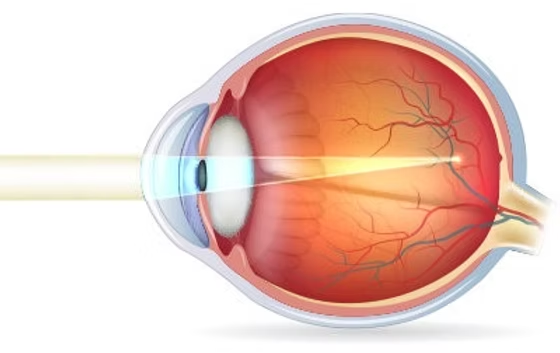
Myopia is also known as ‘short-sightedness’ or ‘near-sightedness’. As the common name suggests, an individual with myopia can see nearby objects clearly but may not be able to see objects far away clearly. Myopia commonly occurs when the lens focuses the light too “strong” causing the light to be focused before the retina instead of on the retina (refer image above) this condition can also be caused the eye ball being long or both of these two factors. Myopia typically develops in early childhood and can worsen with age as the shape of the eye changes over time. Excessive screen-time and not enough time spent outdoors can lead to more severe cases.
What is hyperopia?
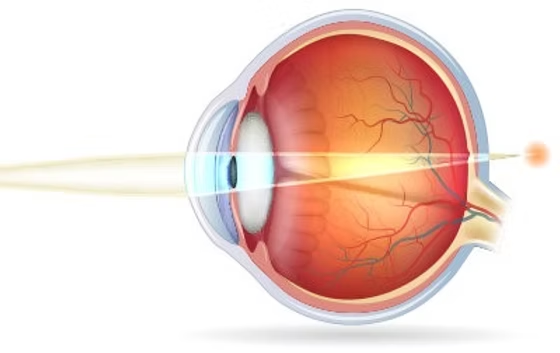
Hyperopia is also known as ‘long-sightedness’, ‘far-sightedness’ or ‘hypermetropia’. This condition causes the affected individual to be able to see far objects clearly and unable to see nearby objects clearly. This usually occurs when the cornea (or lens) is less curved than normal, the eye is too short, or a combination of these factors. Being opposite of myopia, the lens is not focusing the light strongly enough, meaning light focuses behind the retina, rather than directly on it. Long-sightedness can occur at any age but often gets worse after the age of 40.
What is astigmatism?
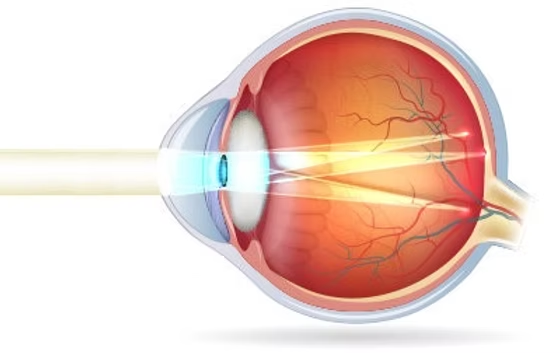
Astigmatism is characterized by blurred or distorted vision, usually at all distances. Main cause of astigmatism if the shape of the cornea, for example, when it is shaped more like a rugby ball than a football. This condition causes the light rays to be refracted unevenly and do not focus at a single point on the retina. Most people have some degree of corneal asymmetry, hence, making astigmatism a very common diagnosis. In most mild cases, many wouldn’t release it until a regular eye exam is done. However, some patient may suffer from the severe astigmatism which can cause much distorted vision – as though looking through a funhouse mirror.
What is presbyopia?
Unlike myopia, hyperopia and astigmatism, Presbyopia causes progressive visual decline at later stage of life, typical between the ages 40 – 65. Key factors contributing to this condition is the eye’s lens becoming more rigid, and at the same time the muscles around the lens weaken. As a person ages, the lens loses this ability to become more convex (typically it should to enable your eye to focus on nearby objects) and, as a consequence, the image does not focus on the retina. It is no uncommon for older people to develop presbyopia and other refractive errors such as myopia or astigmatism.
How are refractive errors diagnosed & treated?
Refractive errors are diagnosed during a comprehensive eye exam with an optometrist or ophthalmologists. During the exam, visual acuity test (A measure of how clear your vision) is done. Refraction tests are also commonly used to check how well your eyes can focus light, and if corrective glasses or contacts are needed to adjust the refractive power.
Latest Posts
Eyedrop replacing eye surgeries? iDrKavitha | Melaka
Eyedrop replacing eye surgeries? iDrKavitha | Melaka Medical advanceme
8 Signs You Need Comprehensive Eye Examination
8 Signs You Need Comprehensive Eye Examination Overview The eyes are v
Is it okay for kids to wear contact lenses?
Is it okay for kids to wear contact lenses? Often times, parents may w
Do you know you could be suffering from Digital Eye Strain?
Do you know you could be suffering from Digital Eye Strain? Digital Ey
Computer Vision Syndrome in Kids – What You Need to Know (2021)
Computer Vision Syndrome in Kids – What You Need to Know (2021) I’
Pterygium – All you have to know about it!
Pterygium – All you have to know about it! A pterygium is a grow
